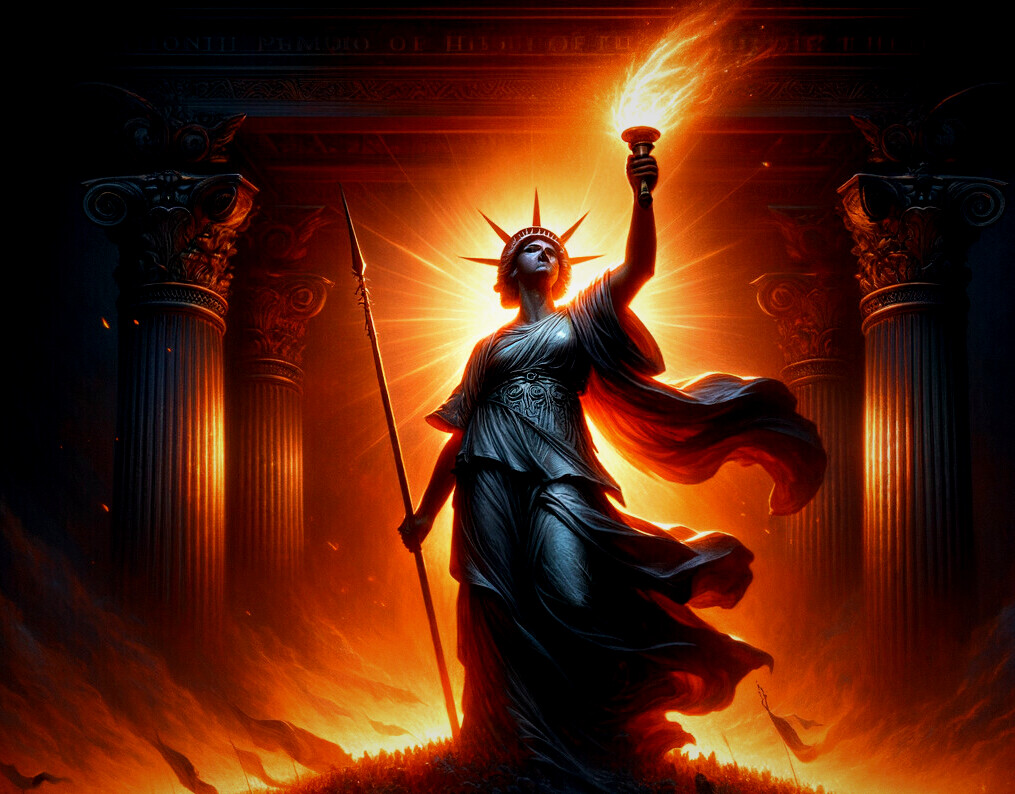
Don’t Argue with the King, Pull the Bolts out of the Throne

Ode to the Quiet Fire

There are hours when history leans close
and whispers that the night is winning.
When banners are torn,
when voices falter,
when the faithful begin to doubt their own memory
of what daylight ever looked like.

This is not the hour of triumph.
This is the hour of endurance.

We have known this road before.
Our forebears walked it without certainty,
without applause,
often without witness.
They did not march believing victory was guaranteed —
they marched because surrender would have meant
forgetting who they were.

There is a kind of courage older than success.
It does not roar.
It does not demand recognition.
It burns quietly, like a coal carried through ruin
so that one day a fire might be lit again.

This courage does not deny the darkness.
It names it.
Stands within it.
And still refuses to kneel.

It is the resolve of those who fought
knowing they might lose,
but also knowing that how they fought
would decide what kind of world remained
for those who came after.

Hope, in such moments, is not naïveté.
It is rebellion.

Not the hope that expects rescue —
but the hope that says:
Even if we fall, the light will not die with us.

This is the hope that moves hands when hearts are tired.
The hope that binds small acts into something greater.
The hope that teaches us that no single blow ends tyranny —
but that tyranny cannot survive a people
who refuse to forget themselves.

Carry that fire now.
Not loudly.
Not recklessly.
Carry it faithfully.

Let it warm your resolve when despair presses close.
Let it remind you that you are not alone —
that countless others, across time,
stood where you stand now
and chose to hold the line anyway.

History does not always reward the just.
But it is shaped by them.

And when the dawn finally comes —
as it always does, in its own time —
it will be because, in the longest night,
someone kept the fire alive.

Let that someone be us.

The Broom, Not the Storm: How Accountability Returns in Dark Moments

Many of us are in shock or are angry right now.

Shock doesn’t mean apathy.
Shock doesn’t mean surrender.
Shock is what happens when people who care suddenly realize the ground has shifted faster than expected.

History shows that moments like this are not resolved by a single act, a single hero, or a single revelation. They are resolved the same way institutions are rebuilt after corruption, capture, or collapse: slowly, deliberately, and together.

That process has a shape. It is not dramatic — but it is powerful.

The broom, not the hammer

A broom is not one solid object.
It is many thin, flexible fibers — each one weak on its own.

One fiber does almost nothing.
Ten fibers hint at motion.
A hundred fibers begin to gather dust.
Bound together, they move what none could move alone.

Accountability works the same way.

Each document preserved
Each contradiction noted
Each authorization traced
Each policy clarified
Each voice added to the public record

On its own, it may feel insignificant — even futile.
Together, it becomes visible. Then undeniable. Then emotionally resonant.

That is where hope lives: in aggregation.

A pattern we already understand

There is nothing radical about this approach. It is the same method the Department of Justice has used for decades when confronting organized crime, corruption networks, and entrenched power structures.

You do not begin at the top.
You begin where authority becomes operational.

Mid-level actors matter because they are where:

  • policy becomes practice

  • orders become paperwork

  • discretion replaces abstraction

  • deniability must be actively maintained

No system — DHS, DOD, DOJ, or otherwise — functions on brute force alone. It functions on confidence: confidence that actions will not be examined closely, that records will remain fragmented, that scrutiny will fade.

Sunlight does not need to be blinding to be effective.
It only needs to be persistent.

What the public actually does in moments like this

When formal oversight stalls or fractures, the work does not disappear. It redistributes.

Journalists, researchers, lawyers, and ordinary people take up small pieces of the broom:

  • preserving records

  • asking precise questions

  • linking incidents into patterns

  • documenting who authorized what, and when

  • keeping memory alive when institutions would prefer amnesia

This is not about accusation.
It is about clarity.

Each fiber adds a little more light.
Each layer makes denial harder to sustain.
Each pass of the broom clears just enough dust for others to see the floor beneath.

Why this should give us hope

Hopelessness thrives on the belief that nothing accumulates.

But history tells a different story.

Accountability rarely arrives as a thunderclap.
It arrives as a weight — built gradually — until systems must either reform or expose themselves fully.

Mid-level accountability changes internal behavior long before headlines change.
Documentation alters risk calculations quietly.
Discovery reshapes what people are willing to defend.

And once that process starts, it is very difficult to stop — because it does not depend on a single actor.

We are not alone, and we are not powerless

If you are feeling overwhelmed, that does not mean you are failing.
It means you are human, awake, and paying attention.

The work ahead is not to panic — and not to despair.
It is to keep adding fibers.

One story.
One record.
One question.
One connection.
One act of memory.

Bound together, those fibers become something real.
They create motion.
They create clarity.
They create the conditions for accountability to return.

That is not naïve hope.
That is historical hope — the kind that has carried societies through darker moments than this.

And it begins, quietly, with the broom.

1 Like