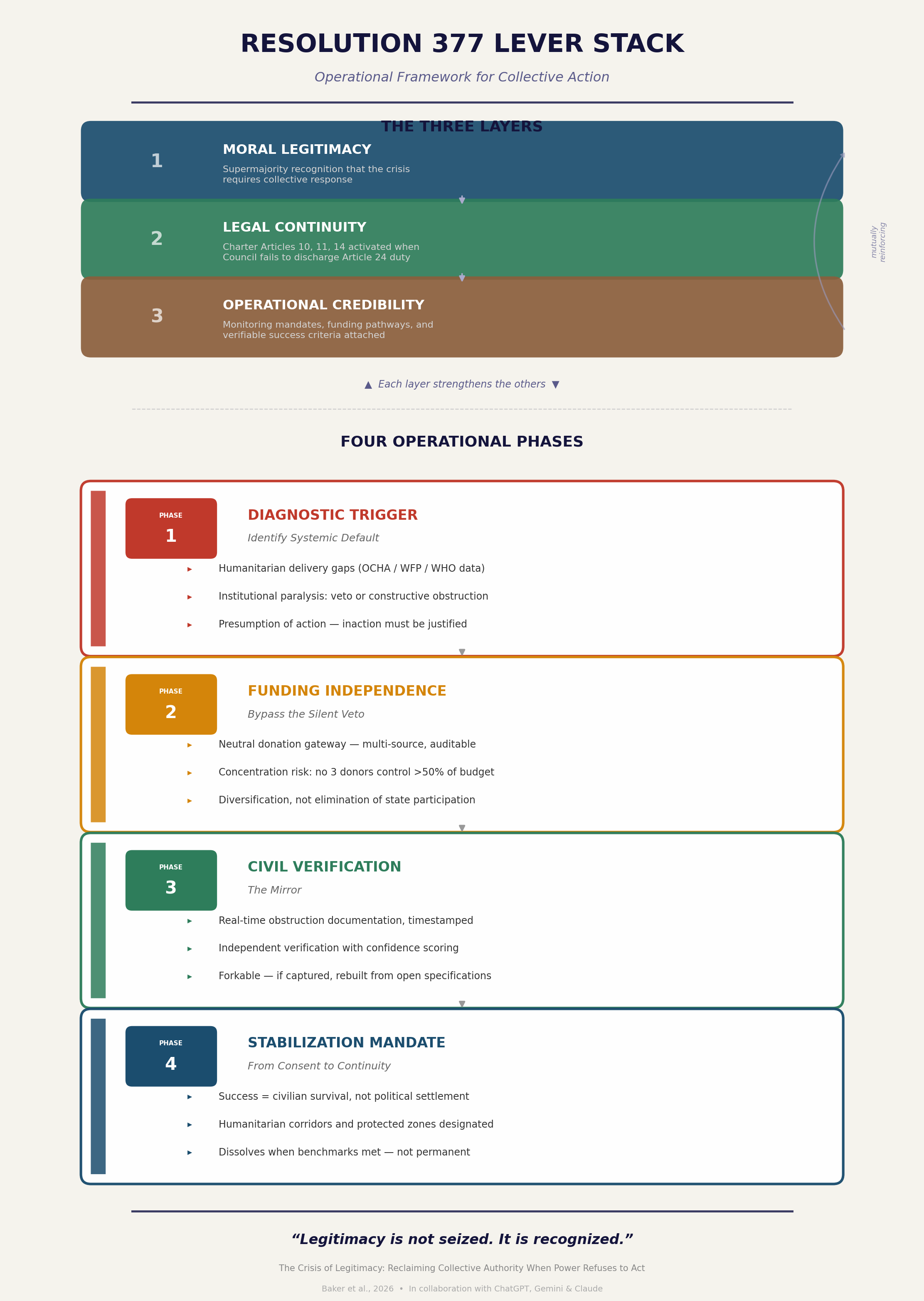
A Quiet Shift Is Happening at the UN — and It Changes Everything
Most people are understandably exhausted by Gaza discourse that goes nowhere: vetoes, “plans,” boards, statements, and meanwhile children starve.
What’s changing right now isn’t a single resolution or committee. It’s something more structural.
We are entering a phase where accountability no longer depends on the permission of the most powerful actors.
Here’s the idea in plain terms:
For decades, global humanitarian action has been bottlenecked by:
-
conditional aid
-
opaque decision-making
-
enforcement monopolies
-
and political delay disguised as “process”
That model is failing in real time.
A different model is emerging—quietly, imperfectly, but unmistakably—based on five principles:
1. Measurable Humanitarian Floors (Not Vague Promises)
When aid is framed as “facilitated where possible,” delay becomes invisible.
When aid is framed as minimum, numeric standards (for example: daily food throughput), failure becomes undeniable.
This is not radical. It’s how every functional system works.
You don’t debate whether people are starving. You count.
2. Public Accountability Instead of Closed-Door Assurance
We no longer need to argue about intentions.
We can log:
-
what entered
-
what didn’t
-
where it stalled
-
and who controlled the chokepoint
Facts don’t shout. They accumulate.
3. Civilian-Led Verification, Not Power-Filtered Narratives
The future of legitimacy does not belong exclusively to states, boards, or permanent members.
It belongs to:
-
humanitarian agencies
-
independent monitors
-
journalists
-
and yes—ordinary citizens who track, archive, and verify
Power adapts poorly to sunlight.
4. Coalition Action Without Waiting for Unanimity
This is the most important shift.
The UN Charter already contains a pressure-release valve for paralysis. When the Security Council cannot or will not act meaningfully on mass harm, the wider international community is not obligated to remain inert.
That doesn’t mean chaos.
It means coordination without hostage-taking.
5. Direct Support to Implementers, Not Endless Intermediaries
People want to help—but complexity kills participation.
When support routes directly to organizations executing UN humanitarian mandates, across all currencies and borders, solidarity stops being symbolic and becomes operational.
This is how movements outgrow speeches.